
Canto VII
It's all downhill from here

In canto 7 we move from sins of the flesh to sins of the ego. Most commentators refer to them as “sins of intellect” and while I agree with the distinction between, say the bodily greed of the gluttonous and the psychological greed of the avaricious, I think that because we speak of afflictions of the mind, and therefore the psyche, the ego is a more precise root for the sins we’re about to discuss than intellect.
I see why “sins of intellect” is such a compelling categorisation, though. Canto 7 opens with a gibberish incantation coming from the mouth of a barely human demonic creature and what better literal representation of the corruption of human intellect than the loss of language? Think of the tower of Babel, which we’ve already briefly touched upon a few weeks ago: a story of how human arrogance led to the loss of mutual comprehension. But I digress.
The opening line of the canto comes from Pluto, the Greek god of material riches, and here described as a rabid wolf-like beast, reminiscent of the she-wolf from canto 1. So, she-wolf, Greek god of material riches… I wonder what sin this canto is about?
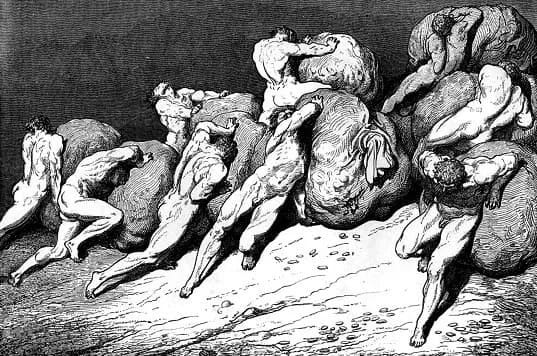
After Virgil intercedes on Dante’s behalf and essentially tells Pluto to fuck off, we are presented with one of my favourite images yet: a Sisyphus-inspired crowd of people who are pushing heavy boulders around in a semi-circle. On one side, Virgil says to a puzzled Dante, are the avaricious, on the other, the spendthrifts. They meet in the middle and curse at each other, neither side capable of understanding the spending habits of the other.
In canto 6 we saw the physical dimension of greed in the gluttons. Here, we see the psychological dimension of it - greed becomes an inner hunger (note how Virgil shoos Pluto away in v. 9 with the words ‘may fury gnaw you inwardly away’)
So there they are, eternally engaged in the useless yet arduous task of pushing boulders around, a punishment that symbolises their frivolous earthly pursuits. I love the use of Charybdis here, a monster from Greek mythology (famously featured in the Odyssey) who lived near the strait of Messina and who swallowed seawater from below, which created huge whirlpools that were impossible to escape. On the one hand, the image is useful in describing the circular motion of the sinners. On the other, the nautical imagery evokes the concept of greed - in classical literature, it was believed that merchants and their greed were responsible for the end of the Golden Age of Man (see here the Ages of Man according to Greek mythology). But that’s not all. There was another monster that lived in the strait of Messina, Scylla, and it was almost impossible for ships to pass through the strait and avoid them both. The myth gave rise to the expression “to be between Scylla and Charybdis”, which essentially means to be caught between two opposite dangers, the task being to find a way of avoiding both. Don’t you just love language?
This brings us back to our sinners - hoarders on one side, spenders on the other - and Dante’s belief that they are both guilty of the same sin. Mal dare e mal tener (wrongful giving and wrongful keeping) reads verse 58, illustrating Dante’s belief that human behaviour exists on a spectrum and either extreme is sinful. Dante didn’t exactly get there all on his own. The coupling of the two sins is suggested by Aristotle in the Nichomachean Ethics. Like Aristotle, Dante identifies virtue as the mean between these two extremes.
You will have noticed that this time Dante doesn’t speak to anyone. Moreover, Virgil tells him that he wouldn’t physically recognise anyone, so he shouldn’t bother. In addition to the loss of language, intellectual corruption appears to also cause a certain physical decay. This could be an excuse to criticise the Church without attacking anyone in particular (see v.47-48). But I see it mainly as an emphasis on how sinful existence renders man nameless and faceless.
And since fortune in the material sense of the word is being discussed, Fortune in the providential sense also comes up. Before we get into Dante’s ideas as to who Fortune might be, a little note on a verse I like. 72 reads “feed on my words” (Virgil is the one explaining to Dante, and us, how Fortune works), which I find funny since Dante is the one who puts words in Virgil’s mouth, as it were. It is Dante that “imbocca” (in Italian imboccare literally means to spoon-feed) the words to Virgil. Conversely, so much of the Comedy is influenced by the Aeneid and Virgil’s entire work was fundamental to Dante’s literary production. It’s not hard to imagine a young Dante “devouring” Virgil’s text as a student. So I really like what he did here.
Fortune herself is an angelic creature, a minister of material goods. The personification of fortune or a person’s fate as a woman (or more - see Moirai) is a classical literature/ mythology trope, so this is another example of Dante’s constant interweaving of pagan and Christian mythology. The inner workings of her decision-making process are very conveniently incomprehensible to the human mind, we are told. But I think it’s worth noting that the lexical register here is more elaborate, unusual for Inferno. It’s as if it were anticipating the passage of canto 28 of Paradiso where Dante describes angels as the highest form of intellectual being whom God designated as governors over the movements of the physical cosmos.
The last 30 verses of the canto mark a distinct structural rupture from the previous six cantos. So far, the rule has been that each canto focuses on one circle and/or one group of damned souls guilty of the same sin. The end of canto 7 bucks this trend with a description of the river Styx and the introduction of the sinners it homes, the wrathful and the melancholic.
Like the avaricious and spendthrifts, the wrathful and the melancholic also represent opposite ends of the same spectrum. The way Dante sees it, anger and sadness both stem from hatred, but while wrath is an excessive outward expression of that hate, sadness is seen as the act of wallowing in hate and letting it seep through one’s pores until it reaches their core and embitters their whole existence from the inside. Simply put, active hate and passive hate.
Note the choice of name for the swampy river they are destined to inhabit: the most popular etymology for the word Styx traces its origin back to “hate” or “loathing”, while another suggests “sorrow”, further linking placing wrath and melancholy in a dichotomy.
The idea of active and passive hate that I chose to run with is reflected in the respective physical punishments of these two groups of sinners. The wrathful, halfway submerged in the swampy water are constantly fighting and biting one another, while the melancholy are fully submerged. Also worth mentioning that one etymology of “wallow” suggests the action of rolling around in mud or water or a combination of the two… kind of like a swamp. Again, isn’t language sooooo great?
None of the wrathful to melancholic get to speak to Dante either, although we do get a strange translation of the bubbles that the melancholic let out by Virgil. What can’t Virgil do? Next thing we know, we’re at the bottom of a tower. What lurks in it, on it, or around it is for me to know and for you to find out next week.