
Canto XIV
It's raining FIRE!

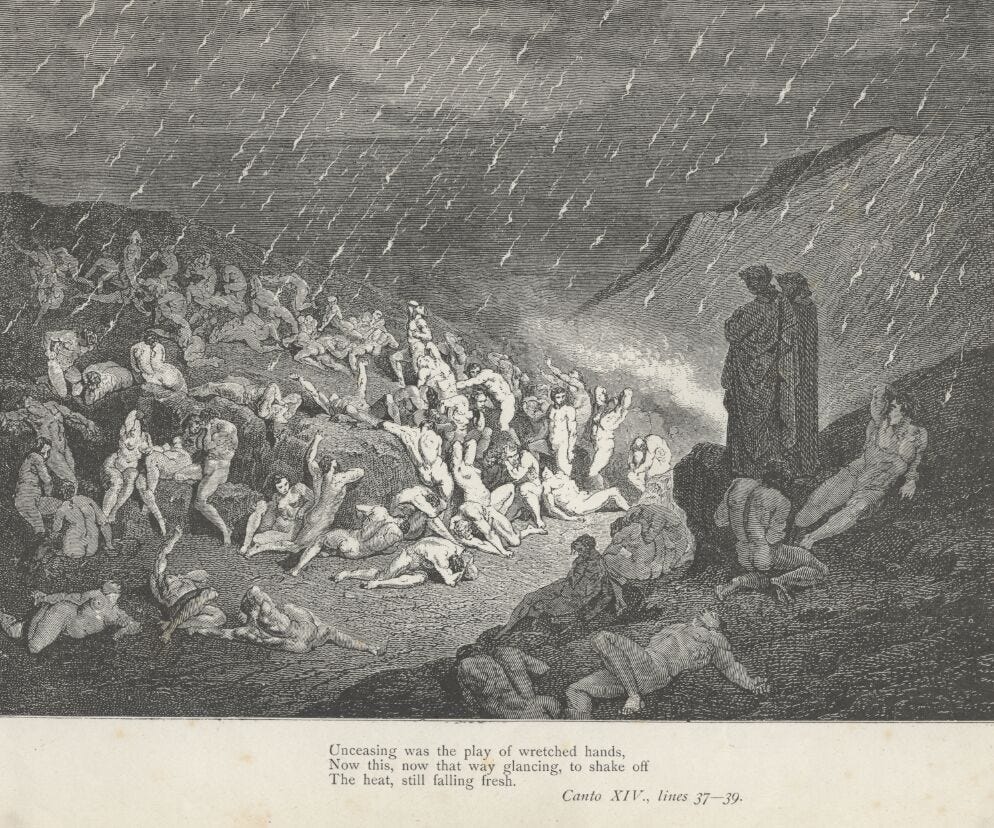
Canto 14 is the first of four cantos we’ll spend in the 3rd ring of the 7th circle, which holds those who in life were violent towards God and nature. There are three kinds of such sinners: those who were sinful in person (blasphemers), those sinful in nature (sodomites - yes, we’ve made it to the homophobic part of the poem), and those sinful in art (usurers). As we’ve grown used to by now, the canto plays out in three acts, starting with a description of the landscape.
The opening verses reprise the closing scene of the previous canto. Dante, overcome by pity for his “countryman”, bends down to pick up the broken branches of the anonymous florentine and lays them at the base of his trunk. As he rises and looks forth, he realises they have come to the edge of the forest of suicides. Before them lies a great arid desert. Flakes of fire from above. The scorching sand burns from below.
A little fun fact about the image of raining flakes of fire - it’s drawn from Albertus Magnus’s De meteoris where the author describes a letter that was supposedly sent by Alexander the Great to Aristotle and in which he described presumably seeing a similar “rain of fire” over his own army in India.
The most striking feature of Dante’s description is the sense of desolation that dominates this first part of the canto. Droves of naked souls are trapped between fire and fire, either motionlessly laying down (blasphemers), crouching and huddling together (usurers), or running to and fro (sodomites). The structure of Hell has got us used to proceed by increasing degrees of horror when it comes to moving from circle to circle. But in the third ring of circle 7, this expectation is subverted. As we can see from the various punishments, the sodomites, which come last, are actually the ones whose sin is less offensive. Critics base this observation on the assumption that by running around, these souls can catch some respite from the fire. The blasphemers, conversely, lay still.
One more so than the other, Dante notices and asks Virgil
That hero there, who’s he? Heedless he seems
Of these incendiaries. Scowling in scorn,
It seems he lies unripened by the rain
(46-9)
The disdain exuding from the sinner’s appearance is strengthened by his first words.
‘What I, once living, was, so dead I am’, he says, thus declaring himself the ultimate unrepentant.
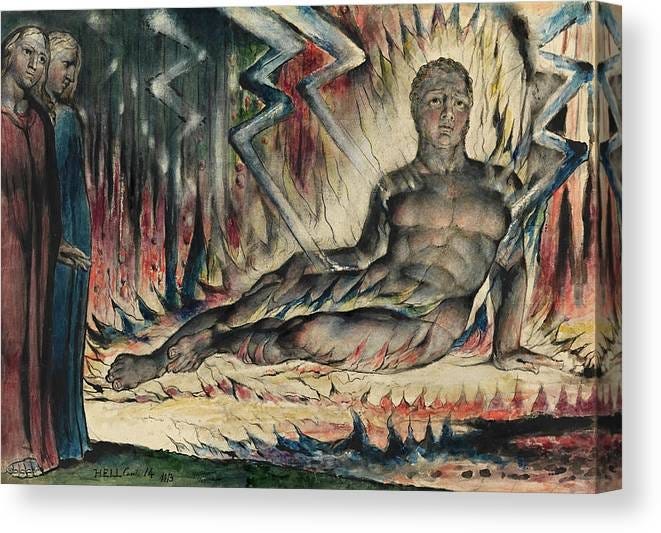
(I love this William Blake image of Capaneus just lounging in the fire)
The speaker is Capaneus, one of the kings who fought in the war of Seven against Thebes. According to Greek mythology, while he was outside the city walls, he cursed at the sky that Zeus himself could not stop him. We see again an intermingling of - even continuity between - pagan and Christian religious traditions. This can be read as an effort to make Christianity look like the only true faith on Dante’s part (and it’s a fairly common gesture in the history of Christianity if you consider all the pagan holidays and practices that have been assimilated under the guise of “they called it by the wrong name but it was God all along”). But I think the main reason Dante blends the two is a more personal one, namely, he is obsessed with classical literature.
Capaneus, then, is unremorseful, something we haven’t seen in the sinners of previous circles. Even Farinata, whose bearing was incredibly dignified throughout his interaction with Dante, had at least acknowledged his sin. Here we see someone who is unmoved. Not physically, despite fire raining down on him, and much less so emotionally. Which invites the question: does punishment have the same weight if its subject regrets nothing? In the logic of Inferno, the physical torture that sinners have to undergo should be enough punishment. But almost every sinner Dante has spoken to thus far has expressed some sort of remorse, leaving us to understand that part of the pain of hell is the unbearable awareness that the individual is solely responsible for their current situation. The individual is entirely responsible for their misery. It is their fault that they will never come to know the true Love of heaven and this is something they have to live with even in death.
Capaneus seems to be immune to this second kind of pain in his prideful determination to continue to scorn god. But in Dante’s Inferno, no one goes unpunished. Virgil’s intervention in verses 63-66 clarifies that despite his disdain, Capaneus is and will forever be a victim of his prideful anger. By continuing to despise god, he continues to burn on the inside as well as out.
In the last part of the canto, we have a bit more myth, which we love. This entire time the poets hadn’t actually stepped onto the boiling sand but skirted the third ring of circle 7 keeping to the edge of the forest of suicides. They walk around looking for a spot where they can pass into the 8th circle safely, and on their way, they come upon a little river, which, Virgil tells us, is special among all the things we’ve seen so far.
Without explaining what makes it so, Virgil starts to tell the myth of the Old Man of Crete, a statue found in a forgotten cave on the island of Crete, whose head was made of gold, shoulders, and arms of silver, and lower body of bronze and iron, with the exception one leg, which was made of clay. The image of the statue brings us once again to the central theme of the current state of corruption in the world that must be saved. This is, after all, Dante’s ultimate ambition in writing the poem.
To fully explain the allegory behind the statue, I must first remind you of the four ages of mankind (I’ve linked to this before but here’s a refresher) It was believed that there was a primordial era when humans lived in perfect harmony and prosperity on earth. This period was generally referred to as the Golden Age of humankind and was curiously located in Crete. Then, as humans became gradually corrupted by vice at the cost of their relationship with the divine, the initial balance was destroyed, resulting in periods of incremental decay, hence the various metals describing these periods in history becoming less and less precious. In Dante’s version of the myth, the statue is covered in cracks and tears fall out of them. The tears pool at the statue’s feet and flow from the cave into the earth, forming the four rivers of Hell: Acheron, which we saw Dante cross in Charon’s boat, the swampy Styx where the wrathful and melancholic dwell, the bloody Phlegethon which holds the homicides at the beginning of circle 7, and Lethe, which we are yet to see.
Once again, we see this mingling of pagan and Christian traditions. Here Dante reconciles the two by drawing parallels between the pagan idea of a “golden age” and the Edenic episode of Genesis. This isn’t particularly hard for him to do as both myths revolve around the same central theme: the corruption of humanity.
This explanatory passage over, we return to the time of narration. Dante and Virgil are still looking for a spot to cross. Who they will meet before getting there we’ll find out next week!